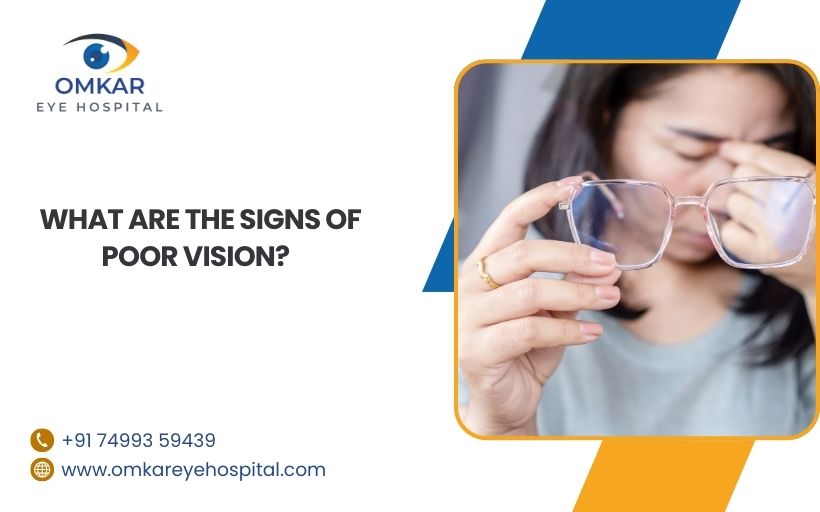
Most people don't lose their vision all at once. It happens gradually, so gradually, in fact, that the brain quietly compensates for the change without ever sending an obvious alarm. You squint a little more. You sit closer to the screen. You assume the headache is from stress, the blurry text is from fatigue, and the difficulty driving at night is just because you're tired.
And then one day you put on someone else's glasses as a joke, and suddenly the world is sharp again. And you realise you had forgotten what sharp looked like.
This is how poor vision works for most people. Not dramatically, not suddenly, but slowly and silently, until the signs have been present for months or years before anyone pays attention to them. At Omkar Eye Hospital, an eye clinic near Elpro Mall, Chinchwad, we see this pattern every week. Patients who come in for a routine check-up and leave with a prescription they needed two years ago.
This blog is about recognising those signs before two years pass. Because the earlier a vision problem is identified, the simpler, more effective, and more affordable the solution tends to be.
Blurred Vision: The One Most People Notice First
Blurred vision is the most obvious sign of poor eyesight, and yet even this one gets explained away surprisingly often. The screen is too bright. The room lighting is poor. I just woke up.
True blurred vision, the kind that signals a refractive error like myopia, hyperopia, or astigmatism, is consistent and progressive. It doesn't clear up after you blink a few times or adjust the lighting. Distant objects that used to be crisp begin to look soft. Text that was once easy to read now requires effort. If you find yourself leaning forward to read a menu or squinting to see a road sign that others around you can read clearly, that is your vision asking for attention, not your lighting.
Blurred vision that comes on suddenly, particularly in one eye, is a different matter entirely and warrants immediate assessment at Omkar Eye Hospital, an eye clinic near Elpro Mall, Chinchwad, as sudden vision changes can indicate conditions requiring urgent intervention.
Frequent Headaches: Especially Behind the Eyes
Headaches are one of the most underappreciated signs of a vision problem, because almost nothing feels less obviously connected to your eyes than a headache.
When your vision is not quite right, your eyes work harder than they should to focus. The muscles responsible for adjusting the lens of the eye, the ciliary muscles, are under constant strain, compensating for a refractive error that glasses or contact lenses would resolve effortlessly. That sustained muscular effort generates tension that radiates as a headache, typically felt behind the eyes, across the forehead, or at the temples.
If you find yourself reaching for pain relief regularly after long periods of reading, screen time, or close work, and the headache reliably follows eye-intensive activity, a vision assessment is a far more useful first step than another packet of paracetamol.
Squinting: Your Eyes' Way of Self-Correcting
Squinting is one of the most instinctive responses to poor vision and one of the clearest visual signs that something needs attention. When you narrow your eyes, you reduce the amount of light entering your eyes and temporarily improve the clarity of what you see. It's an involuntary self-correction that works in the short term and signals a problem in the long term.
If you notice yourself squinting regularly at screens, road signs, or faces across a room, or if others have pointed it out to you, don't dismiss it. Squinting that has become habitual is almost always a sign of uncorrected refractive error. Children in particular may not recognise or report blurred vision, but consistent squinting is one of the earliest observable signs that a child's vision needs professional evaluation.
Difficulty Seeing at Night
Night vision requires the eye to function in reduced light conditions, a task that places greater demands on the visual system and exposes problems that daytime lighting can partially mask. If driving after dark has become something you dread, if oncoming headlights seem to scatter or create halos, if you find yourself slowing down significantly in low-light conditions that don't seem to affect other drivers, your night vision is telling you something.
Difficulty with night vision can indicate uncorrected myopia, early cataract formation, or other conditions affecting the eye's ability to adapt to low light. None of these improve on their own, and all of them are assessable and treatable with the right examination at Omkar Eye Hospital.
Eye Strain and Tired Eyes After Normal Activities
Your eyes should be able to handle a normal day of reading, screen use, and visual activity without feeling exhausted by early afternoon. If they can't, if you find yourself rubbing your eyes frequently, if your eyes feel sore or heavy after tasks that didn't used to cause discomfort, if you need to take regular breaks from reading just to let your eyes recover, that is eye strain, and it is almost always a sign of an unmet visual need.
In today's screen-heavy environment, some degree of digital eye strain is common. But persistent, daily eye fatigue that affects your ability to work comfortably is not something to simply manage around. It is a sign that your visual system is working harder than it should, and that a correction, whether glasses, contact lenses, or another intervention, would make an immediate and meaningful difference to your daily comfort and productivity.
Double Vision
Seeing two images where there should be one, even briefly or occasionally, is a sign that should never be ignored or dismissed as tiredness. Double vision can indicate problems with the muscles that control eye alignment, issues with the cornea or lens, or, in some cases, neurological conditions that require prompt attention.
Occasional double vision after prolonged screen use is worth mentioning to your eye doctor. Persistent or recurring double vision warrants an urgent assessment. If you are near Elpro Mall in Chinchwad and experiencing sudden-onset double vision or worsening vision, visit Omkar Eye Hospital without delay.
Difficulty Reading Small Print
Struggling to read small print, medication packaging, fine text on a menu, or the terms and conditions nobody reads but everyone needs is one of the most common signs of presbyopia, the age-related reduction in the eye's ability to focus on close objects. It typically begins in the early to mid-forties and progresses gradually through the following decades.
Presbyopia is entirely normal, extremely common, and very easily corrected. The mistake most people make is holding small print further and further away, managing the inconvenience until it becomes genuinely disruptive, rather than getting reading glasses or progressive lenses that resolve the problem immediately. If you're reaching for your phone to read, it's time for an eye test.
Sensitivity to Light?
Increased sensitivity to light, finding bright sunlight or artificial lighting uncomfortable, experiencing glare that others around you don't seem to notice, and needing to shade your eyes in conditions that previously posed no problem can indicate several underlying conditions, including early cataract development, corneal issues, or inflammation inside the eye.
Light sensitivity that is new or progressively worsening warrants investigation. At Omkar Eye Hospital, our team will assess the cause accurately and recommend the appropriate course of action, whether that is a simple prescription update or further clinical investigation.
When to Get Your Eyes Tested?
If you recognise any of the signs described in this blog, even mildly or occasionally, the right response is to have a comprehensive eye examination. Not next month. Not when it gets worse. Now.
Vision problems identified early are almost universally more straightforward to correct than those identified after years of compensation and progression. An eye test at Omkar Eye Hospital takes less than an hour, is completely comfortable, and gives you a precise, accurate picture of your visual health, along with a clear plan to address anything that needs attention.
Omkar Eye Hospital is your trusted eye clinic near Elpro Mall, Chinchwad, with experienced ophthalmologists, advanced diagnostic equipment, and a commitment to making expert eye care genuinely accessible to every patient who walks through the door.
Your vision is not something to compromise on. Come in, get tested, and see the world the way it was meant to look.